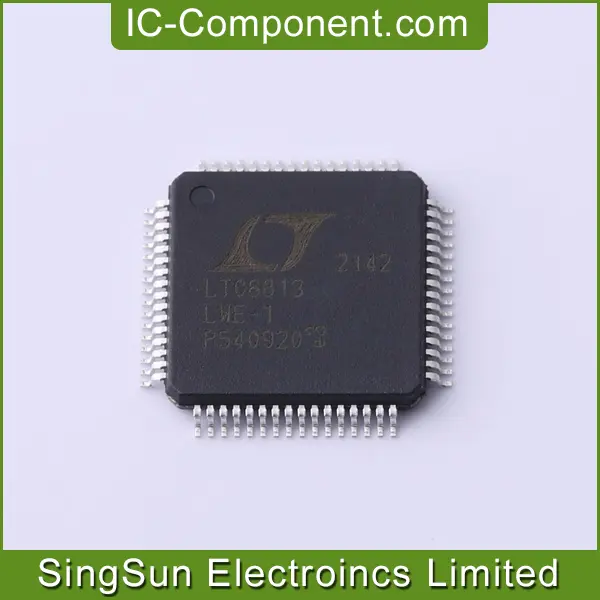
IC BATT MON MULTI 1-18C 64LQFP
| Part Number | LTC6813ILWE-1#3ZZTRMPBF |
| Date Code | 2224 |
| Quantity Available | 21994 pcs |
| Manufacturer | Linear Technology/Analog Devices |
| Lead Time | Ship within 24 hours |
| QTY | 1500 |
| Datasheet | LTC6813-1.pdf |
| Minimum Quantity | More than 50pcs |
| Distributor | SingSun |
| RoHS Status | Lead free / RoHS Compliant |
| Shipment Way | EMS/SF/DHL/TNT/UPS/FedEx |
| Country of Assembly | SOUTH KOREA |
| Country of Diffusion | UNITED STATES |
| Base Product Number | LTC6813-1 |
| Ship From | Hong Kong |
| Packaging | Tray |
| Lot Number | UI34590.18 |
| MSL | 1 |
| Function | Battery Monitor |
| Battery Chemistry | Multi-Chemistry |
| Number of Cells | 1 ~ 18 |
| Fault Protection | - |
| Interface | SPI |
| Operating Temperature | -40°C ~ 85°C (TJ) |
| Package / Case | 64-LQFP Exposed Pad |
| Supplier Device Package | 64-LQFP-EP (10x10) |
The LTC6813-1 is a multicell battery stack monitor that measures up to 18 series connected battery cells with a total measurement error of less than 2.2mV. The cell measurement range of 0V to 5V makes the LTC6813-1 suitable for most battery chemistries. All 18 cells can be measured in 290µs, and lower data acquisition rates can be selected for high noise reduction.
Multiple LTC6813-1 devices can be connected in series, permitting simultaneous cell monitoring of long, high voltage battery strings. Each LTC6813-1 has an isoSPI interface for high speed, RF immune, long distance communications. Multiple devices are connected in a daisy chain with one host processor connection for all devices. This daisy chain can be operated bidirectionally, ensuring communication integrity, even in the event of a fault along the communication path.
The LTC6813-1 can be powered directly from the battery stack or from an isolated supply. The LTC6813-1 includes passive balancing for each cell, with individual PWM duty cycle control for each cell. Other features include an onboard 5V regulator, nine general purpose I/O lines and a sleep mode, where current consumption is reduced to 6µA.